By October 2026 nearly every AI writer produces clean, grammatical prose, so the real differences sit elsewhere. What matters now is how tightly a tool holds a chosen voice, how reliable its facts are, and how likely its output is to copy existing text or trip an AI detector. This article compares the tools people actually use, the frontier chatbots and the dedicated writing platforms, across quality, tone and plagiarism risk.
AI content writers in 2026 fall into two groups that no longer do the same job. The first is the frontier chat models, which include OpenAI's ChatGPT (the GPT-5 and GPT-6 series), Anthropic's Claude, and Google's Gemini. The second is the dedicated marketing platforms built on top of those models, namely Jasper, Copy.ai and Writesonic, alongside Anyword and Rytr.
The chat models supply the raw writing, and the platforms wrap it in brand controls, templates, workflows and governance. Each platform also repositioned around a different job. Jasper is now a marketing "operating system" with brand voice, Canvas and agents. Copy.ai pivoted to workflow automation for sales and marketing teams. Writesonic became a tool for tracking brand visibility inside AI search, with article generation attached.
None of the platforms runs a single model. Jasper routes across GPT and Claude plus its own fine tuned models. Copy.ai spans OpenAI, Anthropic and Google, and Writesonic mixes GPT models, Gemini and Claude Haiku. A platform's writing quality therefore reflects whichever frontier model it calls.
The practical consequence shows up again and again in reviews from people who use these tools. For anyone writing under about 10,000 words a month, ChatGPT Plus or Claude Pro at roughly $20 a month delivers most of the value at a quarter to a third of a platform's price. The platforms earn their premium on brand enforcement, workflows and team features, not on raw prose.
Model version numbers change monthly, so this article compares model families and names specific versions only where current benchmarks do.
There is no single best AI writer. The two leaderboards that rank them crown different winners, and the right pick depends on the task. Raw quality now comes from the frontier models and the platforms inherit it, so the quality question is really about the underlying models.
Two public boards dominate and they disagree sharply. EQ-Bench Creative Writing v3 is a rubric board scored by a large language model. It runs 32 prompts, three times each, and has a Claude Sonnet judge grade the output against a detailed rubric. On it, OpenAI's GPT-6 Astra and Anthropic's Claude Fable 5.1 trade the top at about 2173 and 2162 Elo, with Claude Opus 5 just behind near 2133.
The board based on human votes tells almost the opposite story. On the creative writing category at LMArena and arena.ai, where people vote blind on pairs of answers, Google's Gemini 4 Argon leads, though it is gated and not yet freely usable, with Claude's creative tier near the top. The gap between the boards is extreme. Claude Fable ranks first on the human board and sixth on the rubric board, while Moonshot's Kimi K3 is second on EQ-Bench and twenty third on arena.ai. A model tuned to satisfy a rubric can read as mechanical to people, and the reverse.
On long pieces, where each model writes an eight chapter story that is graded chapter by chapter, Claude Opus 5 tops EQ-Bench Longform at 86.3 across 107 models.
Across both boards, reviewers who use the tools report a consistent division of labour. Claude produces the most natural prose and holds a voice across long documents and strict constraints. The GPT line is the fastest drafter and the best at structure, hooks and churning out many variations to choose from. Gemini is strongest when it writes from a large pile of source material and when live facts have to sit in the draft.
One quality problem is specific to AI. All of these models still produce what writers call slop. EQ-Bench even scores a separate slop metric and a repetition metric, the filler, clichés and overly tidy phrasing that give machine prose away, and cheaper platform tiers such as Writesonic's are described as more generic and more prone to filler than Jasper or the frontier chatbots.
Tone is the area where dedicated platforms justify their price. A raw chatbot will match a voice within one chat, but holding a single voice across dozens of writers and hundreds of pieces is a governance problem, and that is what brand voice engines solve.
Among the platforms, Jasper's Brand Voice is the clear leader. You train it on existing content and it enforces tone, style and banned terms across every output and every team member. Copy.ai's Brand Voice with Infobase comes second. It is competent and improving, and it has the added benefit of grounding company facts to cut hallucination. Writesonic's brand voice tool is weaker. It works, but it does not enforce one voice across all your content the way Jasper's engine does.
Among the frontier chatbots, you control tone with a saved style, custom instructions or a system prompt, plus a few examples. Reviewers single out Claude for holding strict constraints and lists of banned words and for careful edits that leave your voice intact. GPT is the stronger brainstormer but needs more steering to stay on voice. Gemini is flexible, though its plain prose is described as a step behind. Claude's output is also reported to carry fewer of the telltale patterns that make writing look like it came from a machine.
The short version is simple. One person who needs a consistent voice can get it from a chatbot with a saved style. A team that needs the same voice enforced and audited at scale is buying a platform feature, and Jasper leads it.
Plagiarism risk with AI writers rolls together three different things. One is whether the output copies existing text. Another is whether a detector will flag it as written by a machine. The last is whether the model was trained on copyrighted work lawfully in the first place.
The first is copying word for word. Because models train on web and book text, they can sometimes reproduce passages almost exactly, a problem known as memorization or regurgitation. This sits at the heart of The New York Times v. OpenAI. The Times filed over 100 examples of ChatGPT reproducing its article text almost word for word, including paywalled passages, while OpenAI calls it a rare bug and argues the model learns patterns, not expression.
That same case is where the third risk, the legality of the training data, gets decided. As of October 2026 it sits at summary judgment on fair use, with cross motions filed September 4 and replies due November 6. In September the US Department of Justice filed a brief that broadly backs OpenAI's position, the first time the government has weighed in, and no final ruling is expected before 2028. For AI content that gets published commercially, that open question is the real exposure, not the occasional duplicated sentence.
The platforms address copying directly. Jasper includes a plagiarism checker powered by Copyscape that compares your draft against the live web, sold as a paid extra at about $0.30 for the first 200 words and then $0.10 per 100. Writesonic markets its output as 100 percent unique, shown by passing Copyscape. The catch matters. Copyscape checks whether text copies existing pages, not whether it reads like it came from a machine.
The second risk is the one most writers actually face, which is being flagged as AI. Detectors such as Turnitin, GPTZero, Originality.ai and Copyleaks can flag human work, or work written with help from AI, as machine made, and here the marketing and the evidence part ways. Vendors advertise false positive rates under 1%. Turnitin claims under 1% at the document level, GPTZero 0.24% in its own benchmark, and Originality.ai 0.5% to 1.5%. Independent and academic testing finds the real rates are higher, and wildly uneven across writers.
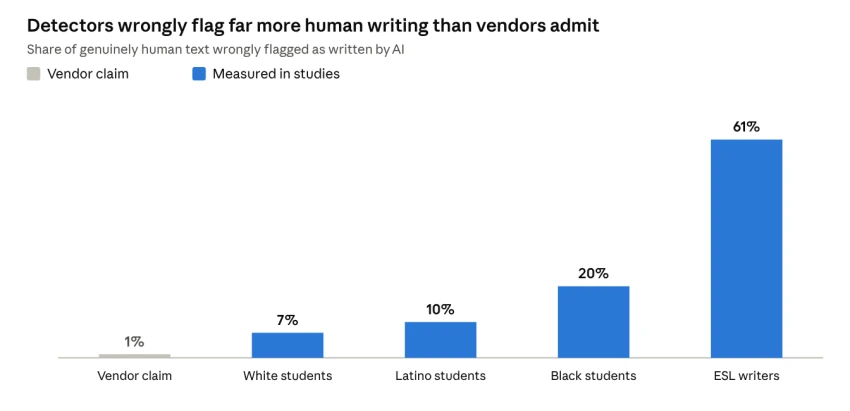
Vendor claims from published benchmarks. Group rates from Common Sense Media and a Stanford study.
The errors fall hardest on specific groups. A widely cited Stanford study found essays by writers whose first language is not English were flagged as AI about 61% of the time, and Common Sense Media reported a 20% false positive rate for Black students against 7% for White students. Research from the University of Chicago Booth in 2025 found that only one tool, Pangram, kept false positives near zero across passage lengths, and GPTZero publicly contested that paper in January 2026.
Two more facts make it clear that a detector score is not proof. Detector accuracy collapses on lightly edited text. One 2026 study found Originality.ai's accuracy fell by about 69% on AI text lightly polished by another model. And because AI prose carries a measurable statistical fingerprint, such as little variation in sentence length, repetition and slop, a plain paraphrase changes the surface words but not the pattern underneath.
The practical conclusion across all three areas is this. No tool can promise that content you wrote with AI will pass a detector, and no detector score should be treated as proof. The sensible workflow is to treat AI output as a first draft, edit it heavily in your own voice, and run a Copyscape style duplication check only when copying word for word is the real concern.
The six tools people actually choose between, lined up on the three axes plus price and best use.
| Tool | Type | Writing quality | Voice and tone control | Plagiarism safeguard | Price (individual) | Best for |
|---|---|---|---|---|---|---|
| Claude (Opus 5.5, Sonnet 5.5, Fable 5.1) | Chat model | Top tier, most natural prose, best on long pieces | Strong, holds strict constraints and lists of banned words | None built in, reported to show the fewest AI tells | Free (Sonnet) or about $20 Pro | Natural long pieces, on brand voice, careful editing |
| ChatGPT (GPT-5, GPT-6 series) | Chat model | Top tier, fastest drafting, strong structure | Flexible, needs more steering to stay on voice | None built in | Free or about $20 Plus | Fast drafts, brainstorming, versatile business copy |
| Gemini (3.x, 4 series) | Chat model | Strong, best from source piles, prose a step behind | Flexible, voice less distinctive | None built in | Free or about $20 AI Pro | Research backed, source heavy, very long documents |
| Jasper | Platform (GPT and Claude) | Strong long form marketing, inherits model quality | Best brand voice enforcement (Brand IQ) | Copyscape duplication check (paid extra) | About $49 to $59 per seat per month | Marketing teams needing one brand voice at scale |
| Copy.ai | Platform (many models) | Good short form, weaker on long pieces | Good brand voice (Infobase), grounds company facts | Not a marketed feature | Free or about $49 a month (workflows cost more) | Sales and go to market workflows, short copy |
| Writesonic | Platform (GPT, Gemini, Claude Haiku) | Competent, cheaper tiers more generic | Basic brand voice, weak enforcement | Markets output as 100 percent unique, verified by Copyscape | About $16 to $39 a month | Budget SEO content, solo creators |
Prices are rough individual rates as of October 2026 and change often. Model version numbers shift monthly.
Most choices come down to three questions. A team that needs one brand voice points to Jasper. A pipeline for sales or marketing content points to Copy.ai. A tight budget for SEO articles points to Writesonic. Everyone else is really choosing between Claude, ChatGPT and Gemini based on what the writing needs.
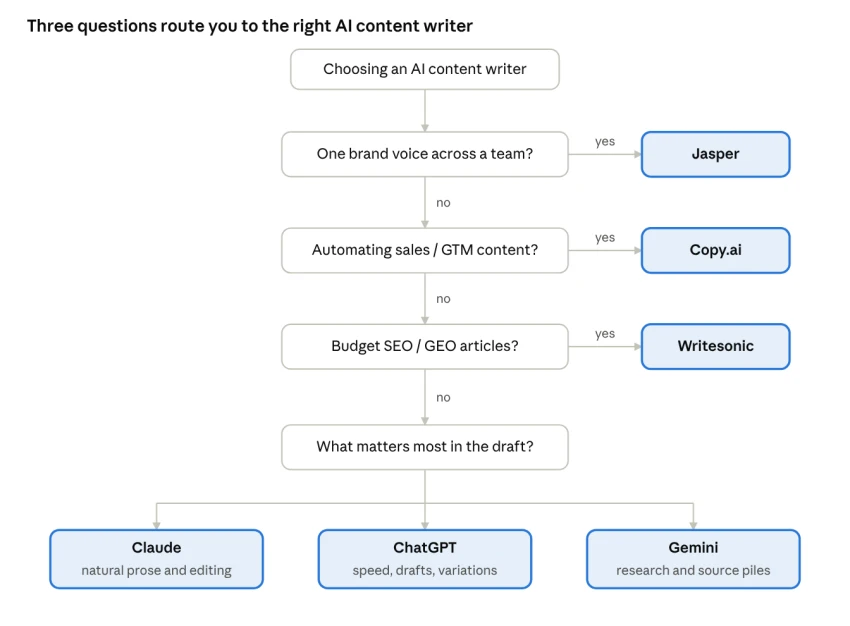
A decision flow from use case to recommended tool
The split at the bottom is the common case. Claude is for natural prose and on brand editing, ChatGPT for speed and volume, and Gemini for drafts that lean on heavy research. Whichever you choose, the originality rules above still apply. Edit heavily, and run a duplication check only when copying word for word is a concern.
After testing these tools across real work, here is where I land. For raw writing I reach for Claude first, because it sounds the most like a person and holds a voice over a long piece without drifting. When I need twenty headline options in a hurry, or a rough draft to react to, ChatGPT is faster and more generous with ideas. Gemini earns its place only when I am writing from a big stack of sources and need the facts kept straight.
My honest opinion on the paid platforms is that most solo writers do not need them. Jasper is worth it when a team has to sound like one brand across hundreds of pieces, and Copy.ai makes sense for sales and marketing teams that want the writing wired into a workflow. For everyone else, a twenty dollar chatbot and a careful edit get you most of the way for a fraction of the cost.
On plagiarism and detection I will be blunt. I do not trust AI detectors, and after seeing how often they flag real human writing, especially from people who learned English later, I would never let a detector score stand as proof on its own. The way I work is simple. I treat every draft as a starting point, rewrite it until it sounds like me, and only run a duplication check when the piece has to be original word for word. That keeps the work honest and keeps me out of trouble.
Related guides and breakdowns from the same category.




Join the conversation
No comments yet
Start the conversation on AI Content Writers Compared on Quality, Tone and P....